72 Ways to Help Prevent ACL Injuries
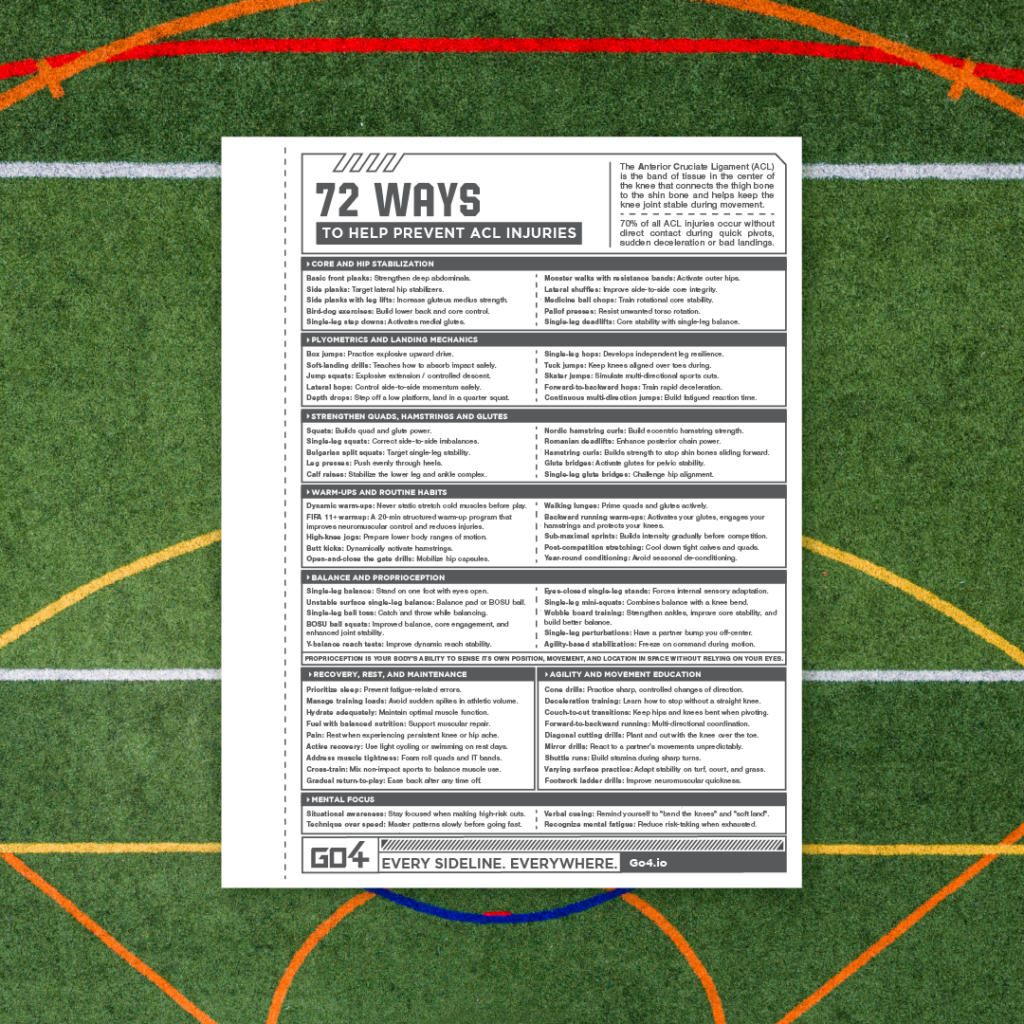
The Anterior Cruciate Ligament (ACL) is the band of tissue in the center of the knee that connects the thigh bone to the shin bone and helps keep the knee joint stable during movement. 70% of all ACL injuries occur without direct contact during quick pivots, sudden deceleration or bad landings. That’s why a lot of these exercises to prevent ACL injuries focus on strengthening the muscles that help with those movements.
Core and Hip Stabilization
Basic front planks: Strengthen deep abdominals.
Side planks: Target lateral hip stabilizers.
Side planks: with leg lifts: Increase gluteus medius strength.
Bird-dog exercises: Build lower back and core control.
Single-leg step downs: Activates medial glutes.Monster walks with resistance bands: Activate outer hips.
Lateral shuffles: Improve side-to-side core integrity.
Medicine ball chops: Train rotational core stability.
Pallof presses: Resist unwanted torso rotation.
Single-leg deadlifts: Core stability with single-leg balance.
Plyometrics and Landing Mechanics
Box jumps: Practice explosive upward drive.
Soft-landing drills: Teaches how to absorb impact safely.
Jump squats: Explosive extension / controlled descent.
Lateral hops: Control side-to-side momentum safely.
Depth drops: Step off a low platform, land in a quarter squat.Single-leg hops: Develops independent leg resilience.
Tuck jumps: Keep knees aligned over toes during.
Skater jumps: Simulate multi-directional sports cuts.
Forward-to-backward hops: Train rapid deceleration.
Continuous multi-direction jumps: Build fatigued reaction time.
Strengthen Quads, Hamstrings and Glutes
Squats: Builds quad and glute power.
Single-leg squats: Correct side-to-side imbalances.
Bulgarian split squats: Target single-leg stability.
Leg presses: Push evenly through heels.
Calf raises: Stabilize the lower leg and ankle complex.
Nordic hamstring curls: Build eccentric hamstring strength.
Romanian deadlifts: Enhance posterior chain power.
Hamstring curls: Builds strength to stop shin bones sliding forward.
Glute bridges: Activate glutes for pelvic stability.
Single-leg glute bridges: Challenge hip alignment.
Warm-Ups and Routine Habits
Dynamic warm-ups: Never static stretch cold muscles before play.
FIFA 11+ warmup: A 20-min structured warm-up program that improves neuromuscular control and reduces injuries.
High-knee jogs: Prepare lower body ranges of motion.
Butt kicks: Dynamically activate hamstrings.
Open-and-close the gate drills: Mobilize hip capsules.Walking lunges: Prime quads and glutes actively.
Backward running warm-ups: Activates your glutes, engages your
hamstrings and protects your knees.
Sub-maximal sprints: Builds intensity gradually before competition.
Post-competition stretching: Cool down tight calves and quads.
Year-round conditioning: Avoid seasonal de-conditioning.
Balance and Proprioception
Single-leg balance: Stand on one foot with eyes open.
Unstable surface single-leg balance: Balance pad or BOSU ball.
Single-leg ball toss: Catch and throw while balancing.
BOSU ball squats: Improved balance, core engagement, and enhanced joint stability.
Y-balance reach tests: Improve dynamic reach stability.
Eyes-closed single-leg stands: Forces internal sensory adaptation.
Single-leg mini-squats: Combines balance with a knee bend.
Wobble board training: Strengthen ankles, improve core stability, and build better balance.
Single-leg perturbations: Have a partner bump you off-center.
Agility-based stabilization: Freeze on command during motion.
Proprioception is your body’s ability to sense its own position, movement, and location in space without relying on your eyes.
Recovery, Rest, and Maintenance
Prioritize sleep: Prevent fatigue-related errors.
Manage training loads: Avoid sudden spikes in athletic volume.
Hydrate adequately: Maintain optimal muscle function.
Fuel with balanced nutrition: Support muscular repair.
Pain: Rest when experiencing persistent knee or hip ache.
Active recovery: Use light cycling or swimming on rest days.
Address muscle tightness: Foam roll quads and IT bands.
Cross-train: Mix non-impact sports to balance muscle use.
Gradual return-to-play: Ease back after any time off.
Agility and Movement Education
Cone drills: Practice sharp, controlled changes of direction.
Deceleration training: Learn how to stop without a straight knee.
Crouch-to-cut transitions: Keep hips and knees bent when pivoting.
Forward-to-backward running: Multi-directional coordination.
Diagonal cutting drills: Plant and cut with the knee over the toe.
Mirror drills: React to a partner’s movements unpredictably.
Shuttle runs: Build stamina during sharp turns.
Varying surface practice: Adapt stability on turf, court, and grass.
Footwork ladder drills: Improve neuromuscular quickness.
Mental Focus
Situational awareness: Stay focused when making high-risk cuts.
Technique over speed: Master patterns slowly before going fast.
Verbal cueing: Remind yourself to “bend the knees” and “soft land”.
Recognize mental fatigue: Reduce risk-taking when exhausted.
To download all 72 ways to help prevent ACL injuries in a handy 1-sheet, fill out the form below.
Other articles you might like
Tournament Operator Series: 7 Things That Should Be at HQ
The Go4 platform is focused on connecting organizations with athletic trainers and insights to help those organizations operate at a higher level. We’re sharing the accumulated knowledge of veteran tournament operators, coaches and club managers. Check out the list of 7 Things That Need to be at…

Go4’s Upgraded Platform
Go4’s Upgraded Platform Launches At Go4.io, we’re always striving to enhance our platform to better serve the athletic training community. We’re thrilled to announce that this version 3.0 of the Go4 platform is live, packed with new features and improvements designed to revolutionize the way organizations hire…

Why Go4 doesn’t set a minimum rate.
As the largest job board in the country for athletic trainers, Go4.io is not just a marketplace; it’s a movement. A movement towards better opportunities, fairer wages, and greater control over one’s professional journey. And that’s why Go4 doesn’t set a minimum rate. 1. The Power of the Marketplace…